Best webhook testing tools for AI coding agents (2026)
Most webhook testing tools were built for humans clicking around a web UI. Some of them now expose an MCP server so AI coding agents can drive the whole workflow. Here's the 2026 state of the market.

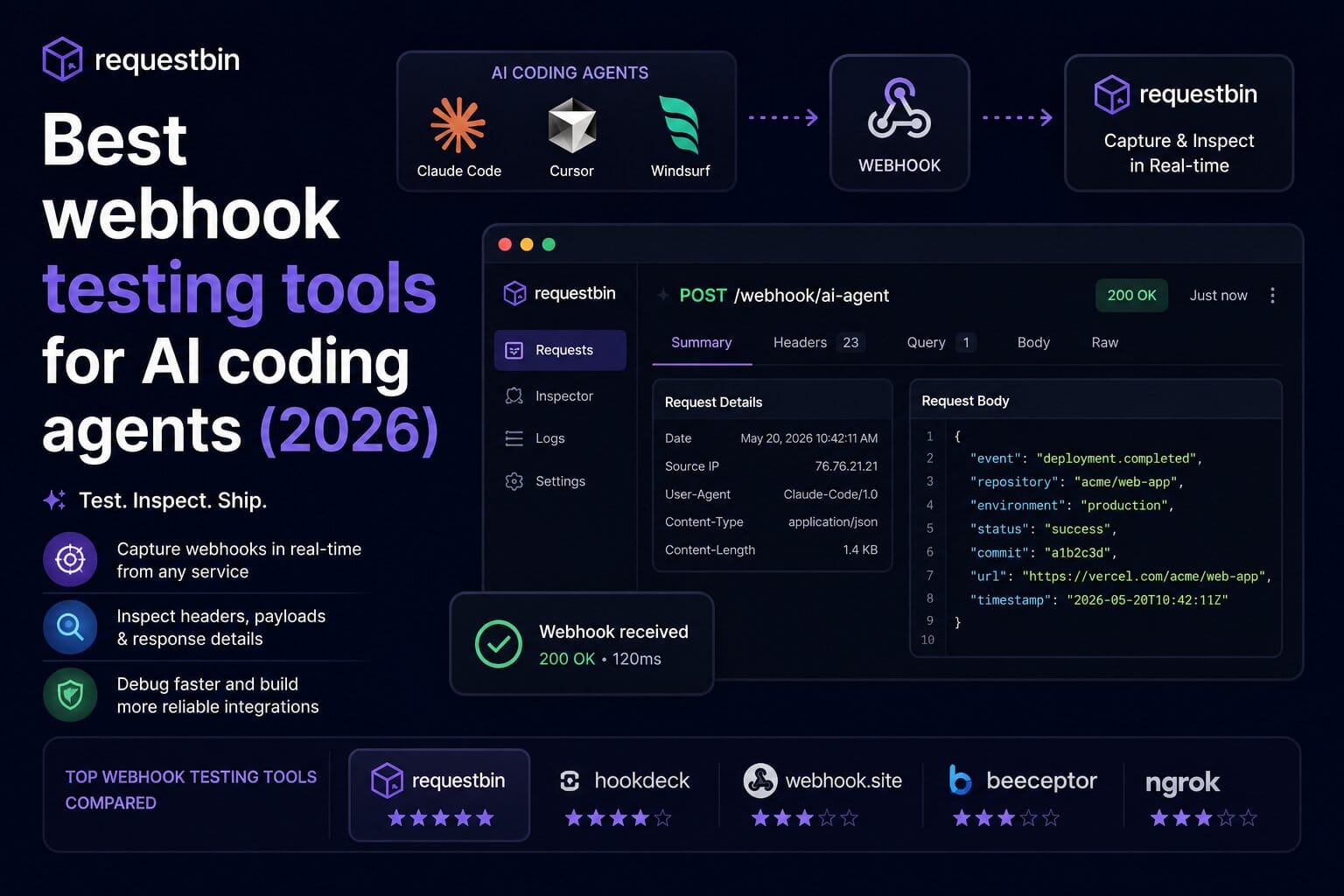
You're using Claude Code, Cursor, or Windsurf to write integration code. The agent writes the Stripe webhook handler. Then what? In 2025 the workflow broke: the agent couldn't reach a webhook tool to actually verify its code worked. You'd manually copy URLs, paste payloads, screenshot results back into the chat.
The Model Context Protocol (MCP) fixed that — tools can expose their workflows as discoverable functions that the agent calls directly. As of 2026 the webhook-testing space has uneven MCP coverage. Here's where we are.
Quick reference table
| Tool | MCP server? | What an agent can do |
|---|---|---|
| RequestBin | ✓ Free | Create bins, list captures, create mocks, configure rules, deploy, verify hits — 13 tools end-to-end |
| Webhook.site | ✗ | n/a — paid REST API exists but no MCP wrapper as of 2026-05 |
| Beeceptor | ✗ | n/a |
| Pipedream | Partial | Trigger workflows via MCP if you wrap them yourself; no first-party webhook-inspection tools |
| ngrok | ✗ | n/a — local-only, no MCP wrapper |
| Hookdeck | ✗ | n/a as of 2026-05 |
What "agent drives the workflow" means
Before MCP, this conversation didn't work:
"Test my Stripe handler against a fake payment_intent.succeeded."
The agent could write a curl one-liner with a hardcoded payload, but it couldn't:
- Spin up a real webhook source the handler treats as production
- Verify the handler actually received the right shape
- Iterate (mutate the payload, re-fire, check again)
With MCP this conversation works:
You: Test my Stripe handler against a fake payment_intent.succeeded.
Agent (Claude Code):Callscreate_mock_endpoint→ getsabc12.rbmock.devCallsadd_mock_rulewith a realistic payment_intent.succeeded payloadCallsdeploy_mockUpdates my code to point at the new mock URLRunscurlagainst the mock to trigger my handlerCallslist_mock_capturesto confirm the mock saw the requestReports: "Handler returned 200, mock saw POST /webhook with stripe signature header, body parsed correctly."
The whole loop runs in one editor session without a browser tab open.
RequestBin MCP tools (2026-05)
Bin (inbound webhook capture):
list_bins,create_bin,get_bin_interactions,replay_request,delete_bin
Mock APIs (outbound canned-response endpoints):
list_mock_endpoints,create_mock_endpoint,add_mock_rule,deploy_mock,list_mock_captures
API key + MCP access is free on every plan (5 keys/account). Paid tier kicks in at scale.
Setup for Claude Code
Edit ~/.claude/claude_desktop_config.json:
{
  "mcpServers": {
    "requestbin": {
      "command": "npx",
      "args": ["-y", "@requestbin/mcp-server"],
      "env": { "REQUESTBIN_API_KEY": "rb_your_key" }
    }
  }
}
Cursor and Windsurf use similar configs in their respective settings files.
What's missing across the market
As of 2026-05, no webhook-testing tool ships MCP servers for:
- Signed-export bundles — for security researchers building report chains. RequestBin has bulk NDJSON export but signed bundles are queued (no MCP wrapper yet).
- Mock-API auto-spec generation — "here's my OpenAPI, give me a mock endpoint that conforms to it."
- Cross-tool replay — capture in tool A, replay through tool B.
If you build webhook-adjacent tooling and want a slot in this picture, shipping an MCP server is the move.
Going further
- RequestBin MCP server on npm
- MCP docs
- Burp Collaborator alternative — uses the bin URL as an OOB-callback target, agent-drivable too